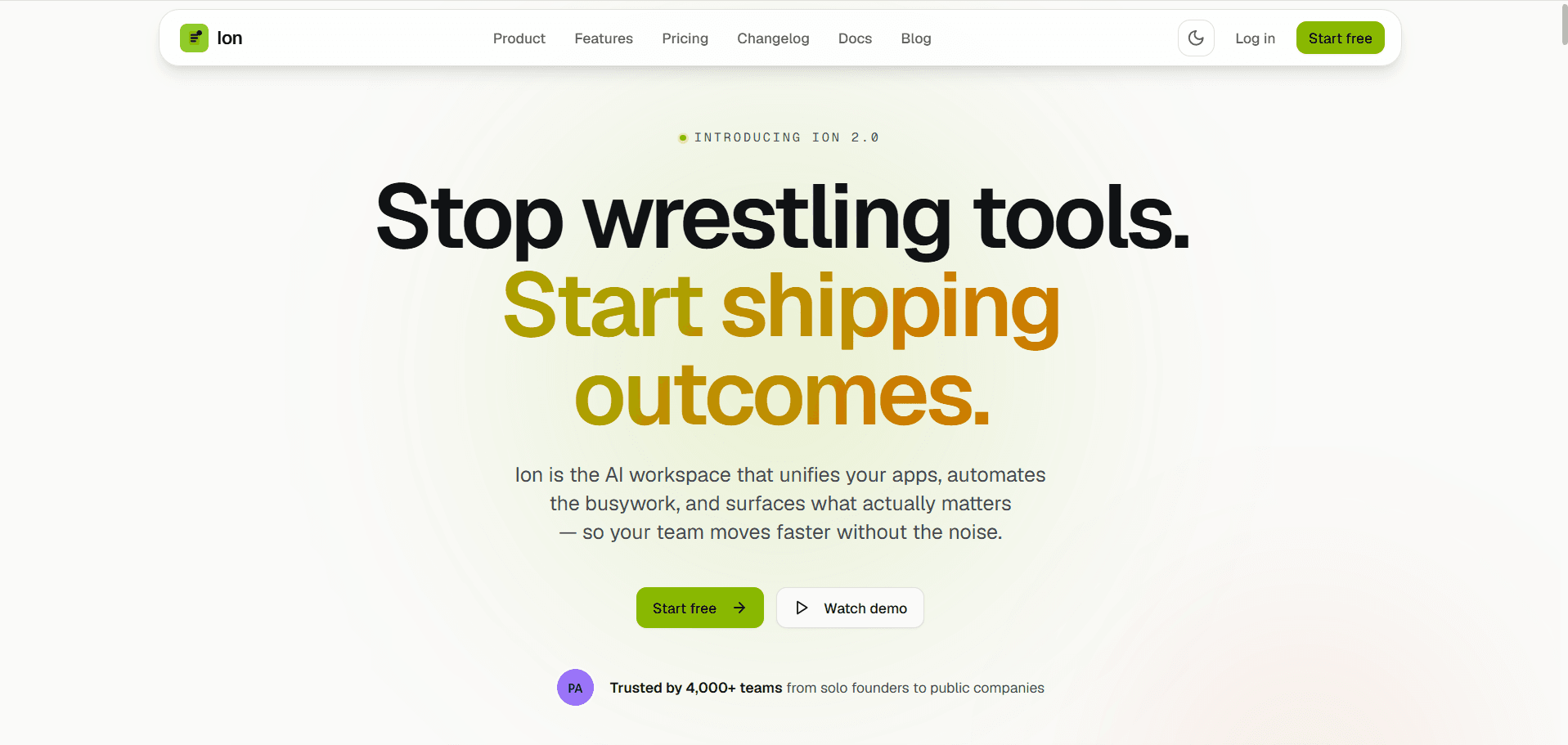
An enterprise AI SaaS website is a connected product system. Buyers move from a search result or article into product education, security review, documentation, pricing, account creation, onboarding, usage, billing, and ongoing support. A single long landing page cannot carry every stage well.
Map The Buyer And User Journey Across Routes
Define which pages serve discovery, technical evaluation, commercial evaluation, trust, account access, adoption, and expansion. Navigation should expose the right depth without overwhelming a first-time visitor.
Ion includes 47 routes across marketing, pricing, blog, documentation, changelog, company, careers, community, security, authentication, dashboard, billing, team, integrations, activity, and legal content. Use that breadth selectively based on the real go-to-market motion.
Explain The AI System With Specific Boundaries
Describe inputs, outputs, user control, review steps, integrations, data handling, limitations, and failure modes. Generic claims about intelligence or automation rarely satisfy technical or enterprise buyers.
Use product demonstrations and documentation together: the marketing page communicates the outcome, while docs explain setup, concepts, APIs, integrations, and operational constraints.
Connect Pricing, Metering, And Billing Language
Pricing labels must match what the product measures—seats, tasks, tokens, documents, workflows, compute, or another unit. Show overage behavior, plan limits, cancellation, and support boundaries clearly.
The customer dashboard should use the same terminology as the public pricing page. Production entitlements must come from verified billing events and server-side access checks rather than client state.
- Define the billable unit
- Document plan and overage limits
- Verify webhooks and reconciliation
- Keep billing and product entitlements consistent
Build Trust Surfaces Early
Security, privacy, data processing, status, support, and legal content often determine whether an enterprise evaluation progresses. Publish only controls, certifications, and contractual commitments that the organization can substantiate.
Add ownership and review dates to policy content, link security reporting channels, and make data retention, subprocessors, and model-training practices discoverable where applicable.
Treat SEO As Information Architecture
Search visibility comes from useful, indexable routes with distinct intent—not from duplicating the same product copy across dozens of pages. Build documentation, comparisons, use-case guides, integration pages, and original research that answer real evaluation questions.
Maintain canonical URLs, descriptive metadata, structured data that matches visible content, an accurate sitemap, internal links, social images, and performance budgets. Measure qualified organic journeys through signup or sales outcomes.
Complete The Production Integration Pass
Connect real identity, organization membership, authorization, database services, AI providers, file storage, billing, email, analytics, monitoring, and audit logging behind typed server boundaries.
Threat-model prompt and file inputs, validate provider webhooks, enforce rate and usage limits, protect secrets, test account recovery, and create operational playbooks before launch.
Explore more on mtverse
Browse dashboard, ecommerce, SaaS, landing page, portfolio, and HTML templates, or explore reusable UI component source.