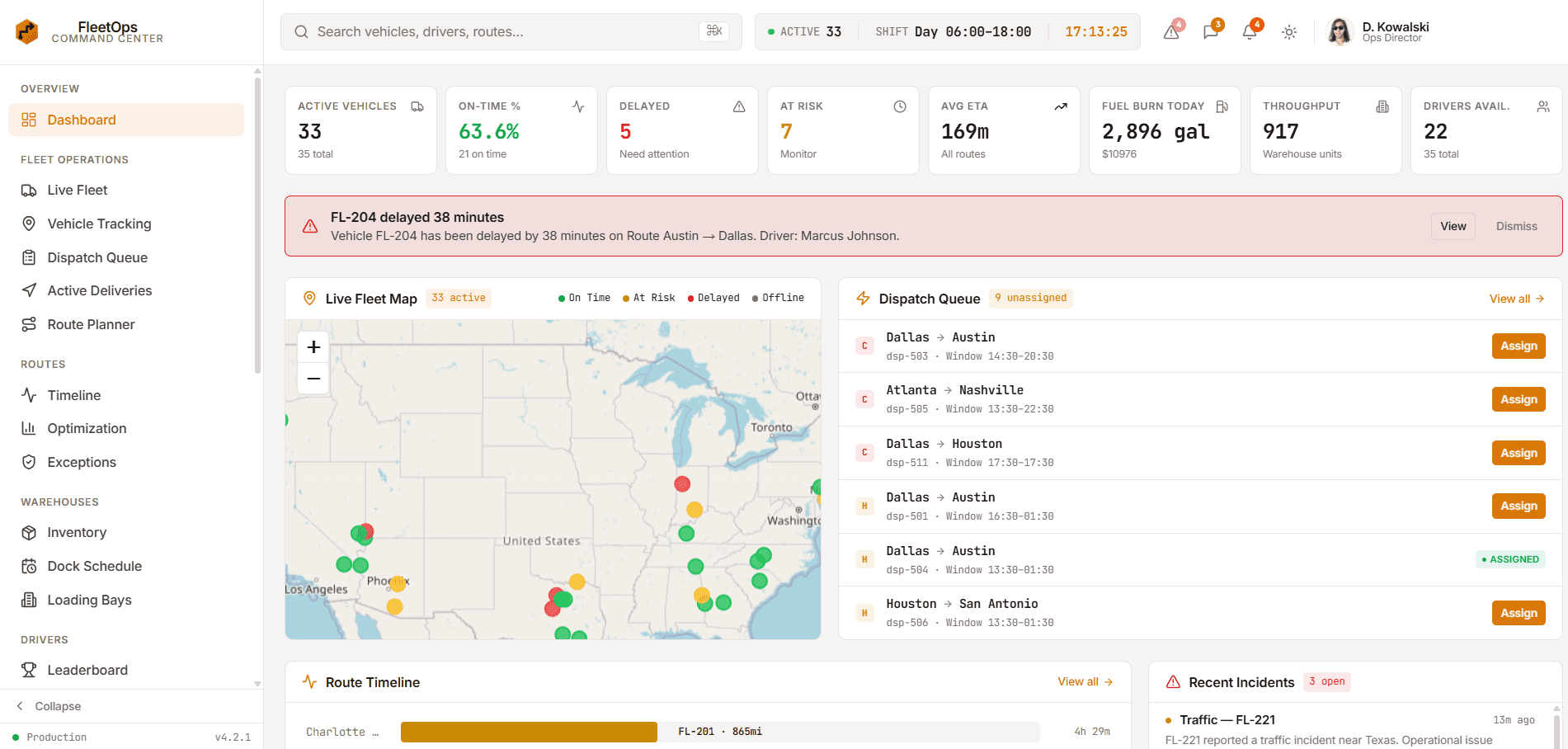
A useful fleet dashboard must support fast operational decisions across vehicles, drivers, routes, warehouses, incidents, and customer commitments. FleetOps is structured as a command center rather than a passive analytics screen.
Design Around Exceptions And Dispatch Decisions
Dispatch teams need delayed routes, unassigned work, maintenance risk, safety incidents, and capacity constraints to stand out immediately. The overview should lead naturally into the queue or record where the issue can be handled.
FleetOps combines KPI status, alerts, dispatch priorities, route timing, and vehicle context so the template can be adapted to last-mile delivery, field service, trucking, or internal transport operations.
Treat The Map As An Operational Tool
A fleet map should communicate status and context, not simply add geographic decoration. Marker state, selected vehicle details, routes, warehouse positions, and list-to-map coordination matter more than visual novelty.
The template uses Leaflet and OpenStreetMap for the demonstration layer. Production teams should connect an approved mapping provider, geocoding policy, telemetry feed, and retention model appropriate to their scale.
Verify Tables, Routes, Drivers, And Warehouses
Vehicle tables require filtering, sorting, pagination, column control, bulk actions, and clear status labels. Driver views need safety and hours-of-service context. Route timelines must reveal schedule risk, while warehouse screens should expose dock and throughput constraints.
Review these connected workflows together. Optimizing one surface without the others can hide the operational handoffs that determine whether a dispatch product is actually useful.
Connect Real Systems Carefully
Replace deterministic demo data through a typed service layer and enforce dispatcher, manager, warehouse, and read-only permissions on the server. Integrations may include telematics, transportation management, routing, fuel, maintenance, messaging, and identity systems.
Instrument assignment, escalation, cancellation, route change, and incident actions. Those events become the basis for operational analytics and auditability after launch.
Explore more on mtverse
Browse dashboard, ecommerce, SaaS, landing page, portfolio, and HTML templates, or explore reusable UI component source.