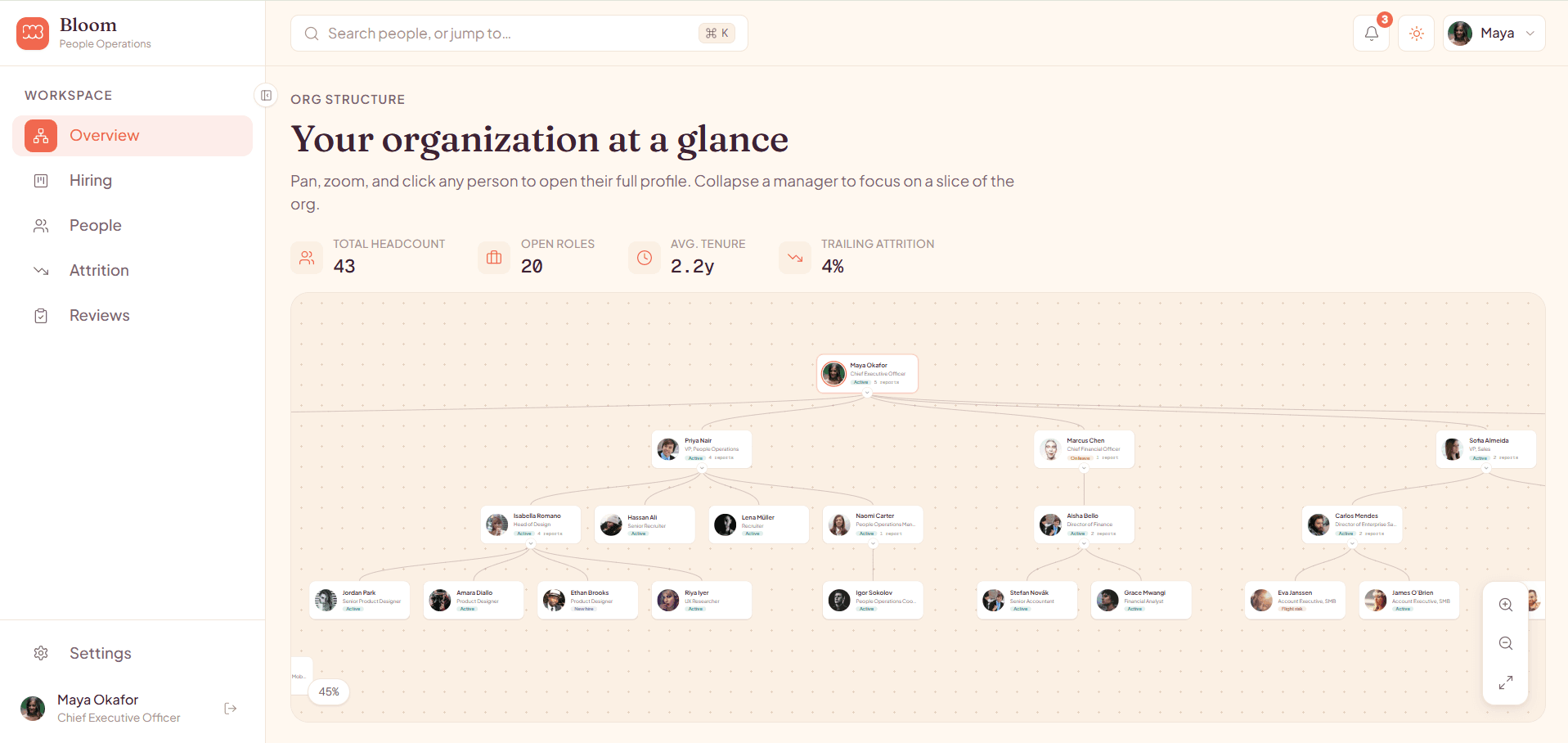
A People Operations dashboard should help HR teams understand the organization, move candidates through hiring, find reliable employee context, monitor retention, coordinate reviews, and administer sensitive settings without stitching together unrelated screens.
Model The Employee Lifecycle Before Choosing Screens
Begin with the transitions the product must support: candidate to hire, employee to manager, team transfer, review cycle, leave, and offboarding. The route structure should preserve context across those transitions.
Bloom connects an interactive organization chart, hiring kanban, employee directory, attrition analytics, performance reviews, profiles, and settings through one responsive application shell.
- List each operator role and decision
- Separate employee records from analytical aggregates
- Define where approvals and audit events occur
- Test cross-links between organization, employee, and review views
Inspect Organization And Recruiting Interactions
An org chart becomes useful when users can navigate large structures, inspect reporting lines, collapse branches, and reach the corresponding employee record. A static illustration is rarely enough for a real HR product.
Recruiting boards need keyboard alternatives, explicit transition states, validation, and a server-side authorization model. Drag and drop can accelerate work, but it must not be the only way to complete a critical hiring action.
Test The Directory With Operational Data
Use long names, missing photos, multiple locations, custom tags, manager changes, inactive accounts, and permission-restricted fields when evaluating a directory. Search, sort, filters, bulk selection, export, and detail panels should remain understandable at real density.
Bloom demonstrates these interaction patterns with typed deterministic records. Production teams should replace them with authenticated services and define which fields may be searched, exported, cached, or exposed to each role.
Treat Retention Metrics As Governed Definitions
Attrition rate, regrettable loss, tenure, headcount, and review completion require stable definitions and documented date boundaries. Calculate production metrics on the server from governed events rather than copying sample chart logic into a reporting system.
The dashboard source accelerates the presentation layer, while the organization remains responsible for data quality, privacy, access review, audit retention, and appropriate interpretation.
Plan The Production Security Pass
HR data can include sensitive identity, compensation, performance, and employment information. Enforce authorization on every API, encrypt data in transit and at rest, limit exports, audit privileged changes, and review vendor and jurisdiction requirements.
Add monitoring for candidate changes, employee updates, permission changes, review requests, data exports, session revocation, and integration connections before launch.
Explore more on mtverse
Browse dashboard, ecommerce, SaaS, landing page, portfolio, and HTML templates, or explore reusable UI component source.