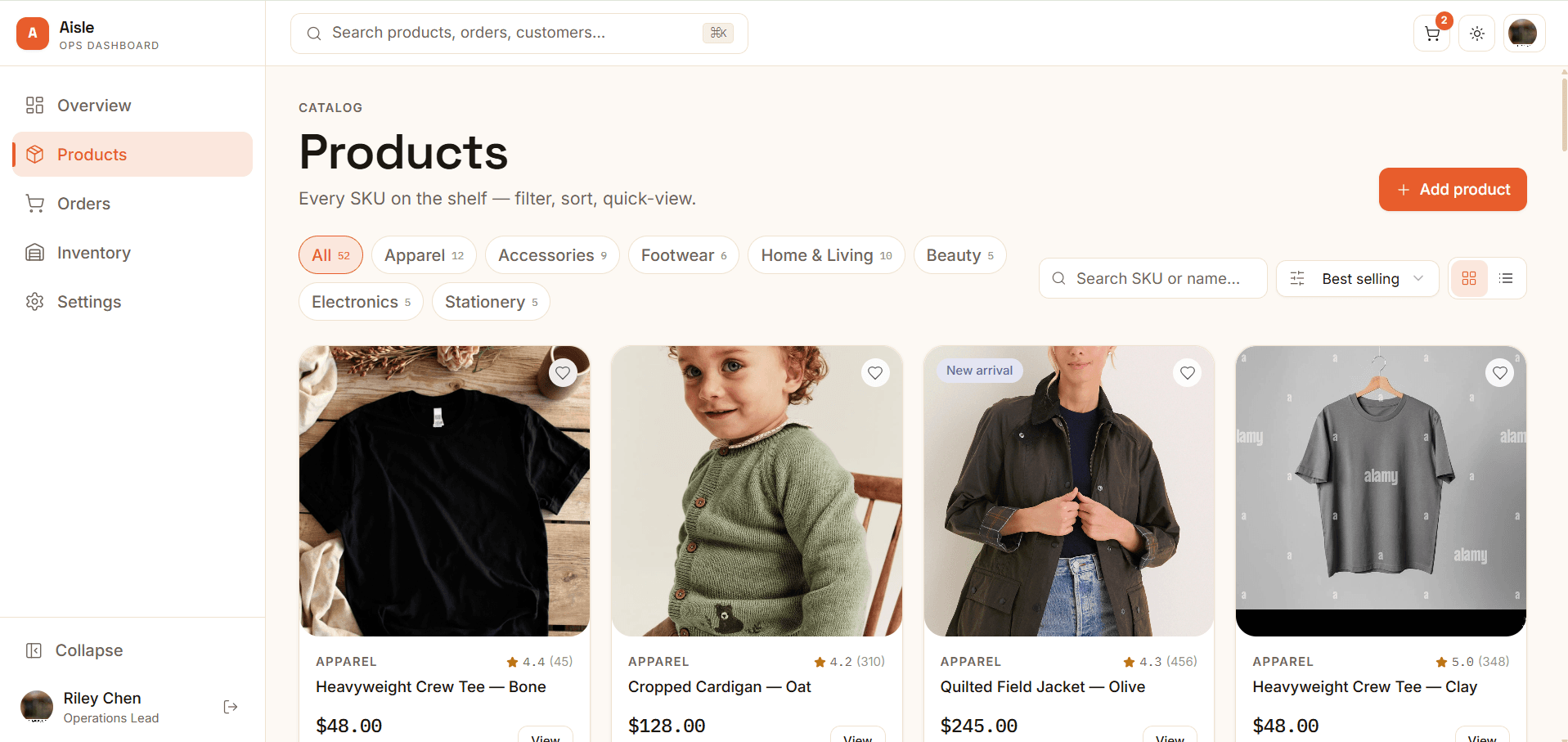
Retail operations products must connect what is selling, what customers ordered, what can be fulfilled, what is running low, and what operators should do next. A visually polished product grid is only one part of that system.
Connect Product, Order, And Inventory Records
The same SKU, price, image, stock level, and order line should remain consistent across overview cards, product detail, fulfillment, inventory, and analytics. Disconnected mock screens hide expensive data-model problems.
Aisle uses a deterministic dataset across 52 products, 100 orders, inventory levels, customer records, and category performance so teams can inspect the intended relationships before replacing the sample layer.
Evaluate Fulfillment As A State Machine
Order status changes should define valid transitions, permissions, idempotency, inventory consequences, carrier handoffs, customer communication, and recovery behavior. Optimistic UI must revert clearly when the server rejects a change.
Test filtering, sorting, pagination, row selection, bulk actions, detail inspection, partial failure, stale data, and repeated clicks. These are more important to daily operators than a large headline metric.
- Define valid order transitions
- Confirm bulk actions report partial failures
- Keep order detail visible during updates
- Instrument every status-changing action
Make Low Stock Actionable
A low-stock signal needs sales velocity, reorder threshold, lead time, open purchase orders, channel allocation, and a clear replenishment action. Color alone is not enough.
Aisle demonstrates stock-level bars, low-stock emphasis, filtering, sorting, and a validated reorder form. Production logic should calculate recommendations from trusted inventory and purchasing services.
Use Photography Without Sacrificing Performance
Real product imagery helps teams evaluate density, aspect ratios, cropping, missing assets, and visual scanning. It also increases package and page weight if images are not resized and delivered intentionally.
Generate responsive derivatives, define image dimensions, use lazy loading below the fold, audit licensing, and monitor largest contentful paint on representative product pages.
Plan Commerce Integrations And Reconciliation
Retail systems commonly connect commerce platforms, warehouses, shipping providers, returns, payments, tax, and customer service. Keep provider adapters behind typed server services rather than embedding vendor payloads in UI components.
Add webhook verification, idempotency keys, reconciliation jobs, role checks, rate limits, and operator-visible sync health before using the interface in production.
Explore more on mtverse
Browse dashboard, ecommerce, SaaS, landing page, portfolio, and HTML templates, or explore reusable UI component source.